
“The map is not the territory…” ~ Alfred Korzybski
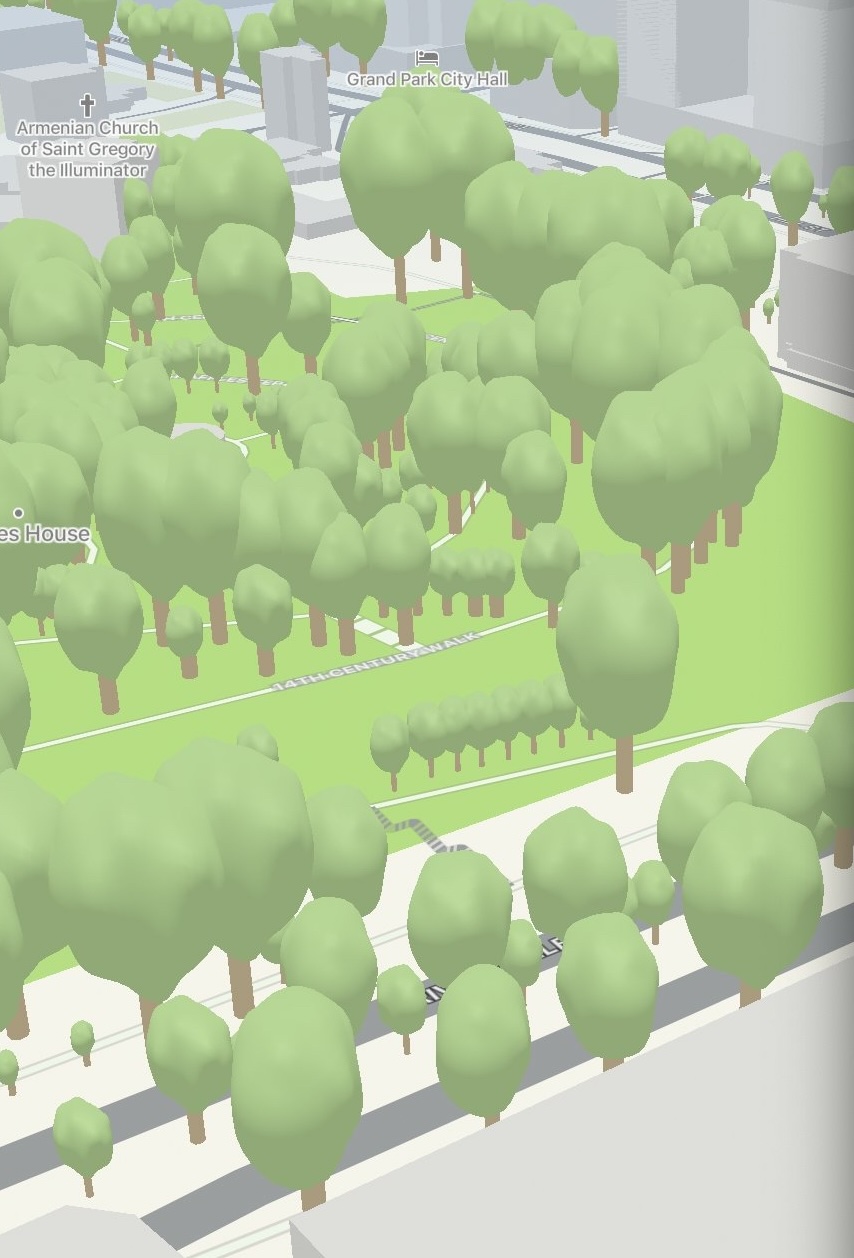
Recently driving my 2025 Elantra Hybrid to a meeting with an author friend who’s in town for research, I used Google Maps to find the most efficient route through morning traffic. I do this all the time, but this time something caught my eye that I hadn’t noticed before. The Elantra has a high-resolution map display when you use Apple Carplay, rendering position and context as an abstract 3D display that includes shapes of buildings and trees along the road. I hadn’t noticed the tree shapes before, but this time they captured my attention.
I realized that the cartoonish virtual trees on the map, while suggesting that trees exist in the environment, didn’t conform to the shape or placement of actual trees. This makes sense, considering that the trees are not essential to the navigation, but I wondered how the map application’s algorithm decides placement, size and shape of those trees? And why have them at all? Neither the Google Maps nor the Apple Maps application includes trees on the computer unless you select the satellite view, which is a photographic display including actual trees and buildings.
I did some research, understanding that the trees are symbolic, not literal. I found that, when the map data suggests that an area has trees, diverse tree icons are rendered algorithmically using an evidently random distribution. The tree shapes and colors are fairly consistent, and spacing depends on context (a park may have less density than a forest).
Why have trees on the map at all? While it’s true as I mentioned that they’re not essential for navigation, the presence of the trees can signal types of areas and assist orientation – e.g., trees might help to identify parks or medians. So including them in rendering can help distinguish one kind of area from another. They make the view a bit less abstract and a bit more human-friendly.
This acknowledgement of the presence of trees, even if the placement and size are not accurate, can make the map feel more realistic, more like the real world, more worthy of user confidence.
So it does make sense to include the trees.
This made me think how so many of us are living in a hybrid reality combining the physical with the virtual. And others less so: the author I met at the end of my drive had a cellphone, not a smartphone, like the bulky iPhone Pro Max that I carry, which is a small computer that combines many functions including voice communication, which I use less than many of its other features. It has a camera the quality of which is comparable to my Nikon SLR. It has apps for games and news and aesthetic play of various kinds. It can stream high quality music and video.
My friend’s phone, though, has two functions, voice and text. No apps, no games, no camera, no music, no video. We discussed briefly how different our experiences of reality must be, given that my perception is persistently filtered through a relatively powerful computing device, and his is not. My attention and experience are mediated to much greater extent by a combination of technology and media that captures my attention much of each day.
I wonder if this commitment to a more virtual reality is a good or bad thing. I’m not sure that it’s either, it’s just one way of experiencing the world; it has its pros and cons. I’m considering a media and technology fast sometime in the near future, to assess a different kind of experience. I have sunk deeper and deeper into virtual experience; my attention is divided, my train of thought has many turnouts and complications.
There are those who advocate hugging real trees as a grounding practice, and a way to connect with nature. In Japan, there’s a practice called shinrin-yoku, or forest-bathing, spending time in a forest or similar natural setting. A likely therapy for 21st century stress. Your avatar might hug virtual trees in virtual reality, but I don’t think it would have the same therapeutic effect.
