
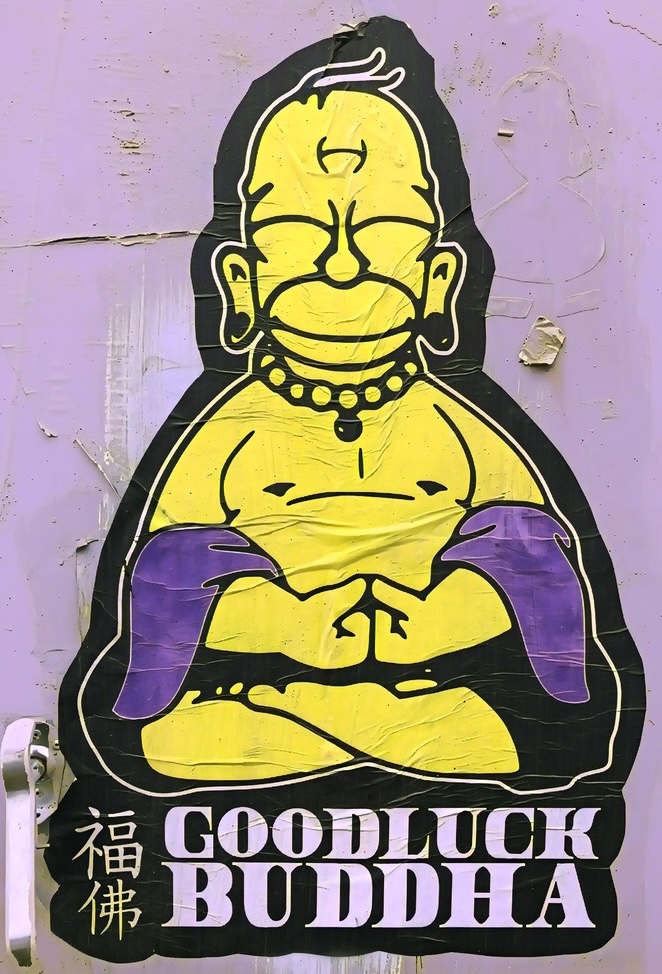
I should probably be cranking out alerts about the dangerous instabilities within the human component of our tiny planet right now, but others are doing that pretty effectively. Instead I’m thinking how we might work on ourselves, how we might explore the nature of consciousness, perception, reality. If we’re more self-aware, if we understand the nature and character of our thoughts and emotions, perhaps we can work better together to help and support each other and our shared experience of life on the blue planet.
I’ve been in some discussions recently, some related to Buddhist practice, and some inspired by Michael Pollan’s latest book, A World Appears.
One idea that keeps resurfacing: the self as interface.
Behind this interface there’s a great deal happening – awareness, which has layers, like an onion. There’s thinking, which is words and images and intentions arising and dissolving internally, guiding us through the waking life. And sometimes tangling us—looping into anxiety when we can’t let go or widen our perspective.
Then there are emotions, powerful, often mechanical forces. Hard to control, sometimes intensely positive or negative, therefore destabilizing. They resist analysis; they live partly beyond our understanding.
And there’s the mystery of sleep: where are we when we’re not awake? Are we still conscious in some sense? What currents are moving through the brain? How do they relate to mind?
A lot of knots to unravel.
That reflection connects to something else I’ve been considering: meditation.
Meditating for relaxation, or even for enlightenment — as a kind of self-improvement project — feels off to me. It risks reinforcing the “self” it aims to transcend.
What seems more aligned is letting go of self-interested goals altogether. Removing obstacles to compassion. Staying open to insight without depending on it. Practicing without measuring success or failure.
But that leads to another question: is meditation related to truth? And do we even know what we mean by “truth”?
Truth is slippery. It might mean correspondence to reality – assuming we can agree what “reality” is. It might mean coherence — fitting within a system of beliefs. It might mean what works, what proves effective in practice.
In lived experience, people rarely adopt beliefs because they correspond neatly to reality. They adopt them because they feel right—because they stabilize meaning in a given context.
So perhaps truth is some combination: something that aligns with reality, coheres with what else we know, works in practice, and feels meaningful.
If I were filling out a form asking for my religious preference, I’d probably write “Buddhist.”
If you asked me face to face, I’d say something more like “Buddhist-adjacent.” I’ve studied Buddhism for over fifty years, but I haven’t followed a traditional path—no single teacher, no consistent sangha, no formal adherence to one school’s rituals or practices.
Still, I suspect that whatever the Buddha realized — and tried to convey — is not dependent on Buddhism as a system. It would remain true even for someone who has never heard of the dharma.
There isn’t just one path to realization. And there are likely many who believe they’ve arrived who haven’t — not really.
