
Originally published at rewired.com
It’s a hassle to edge past 50 and realize that the dreams pumped into your head by "the dreamer fthp" (see Footfall by Larry Niven and Jerry Pournelle, where SF authors form a kind of dreamer caste as seen by elephant-beaked aliens) prove bogus… specifically dreams of space travel, alien contact, and robots, which are all present in 2001: A Space Odyssey, which is a raging zen koan I’ve carried with me for 33 years. For those of you who are not at least backsliding Buddhists, a koan is a riddle that a Buddhist master gives his disciple. Once it’s in the disciple’s head, the koan is like a time bomb ticking away until it explodes as realization. It could be one of the tiny kensho realizations that shape the pathway toward real enlightenment and wisdom, or it could (rarely) be a multi-megaton satori mindfuck that blasts the disciple into a state of profound awareness.
My 2001 bomb has gone off, finally, as we get to that first year of the new millennium…and it’s fizzled, in the sense that we haven’t afforded space travel in the big way envisioned by Clarke and Kubrick and we haven’t found alien artifacts on the moon (though we might have a few outside Roswell?) and artificial intelligence is a bust.
I first saw 2001 in summer 1968, its first release, in the now defunct widescreen format Cinerama, which was the IMAX of its time. (I’ve since seen a version remastered for IMAX, and it was just as amazing as the Cinerama version.) It was part of a pilgrimage of sorts: my friend Freaky Pinky and I set out from West Texas for San Francisco (summer of love) but were waylaid by our wild and woolly friends in Flagstaff. We were distracted from one adventure by another, and this one was as worldly as they come: we drank gallons of Schlitz beer and wandered around Northern Arizona, to Snowbowl and Grand Canyon and down Oak Creek Canyon to Jerome, where we spent time with authentic San Francisco hippie freaks eating rice and herbs and smoking ganja. Eventually our money ran out and my brother asked me to be best man at his wedding, so we aborted the trip and returned to Texas. Before that, though, I told Pinky et al that whatever else happened, we must find a Cinerama theatre so we could see 2001: A Space Odyssey in all its superpanavision glory. And so we did, driving one boring Sunday morning from Flagstaff to Scottsdale, where there was a Cinerama theatre and 2001 was showing.
Though our young minds were pretty well fucked by Kubrick’s expansive vision, we had no idea what we’d just seen.
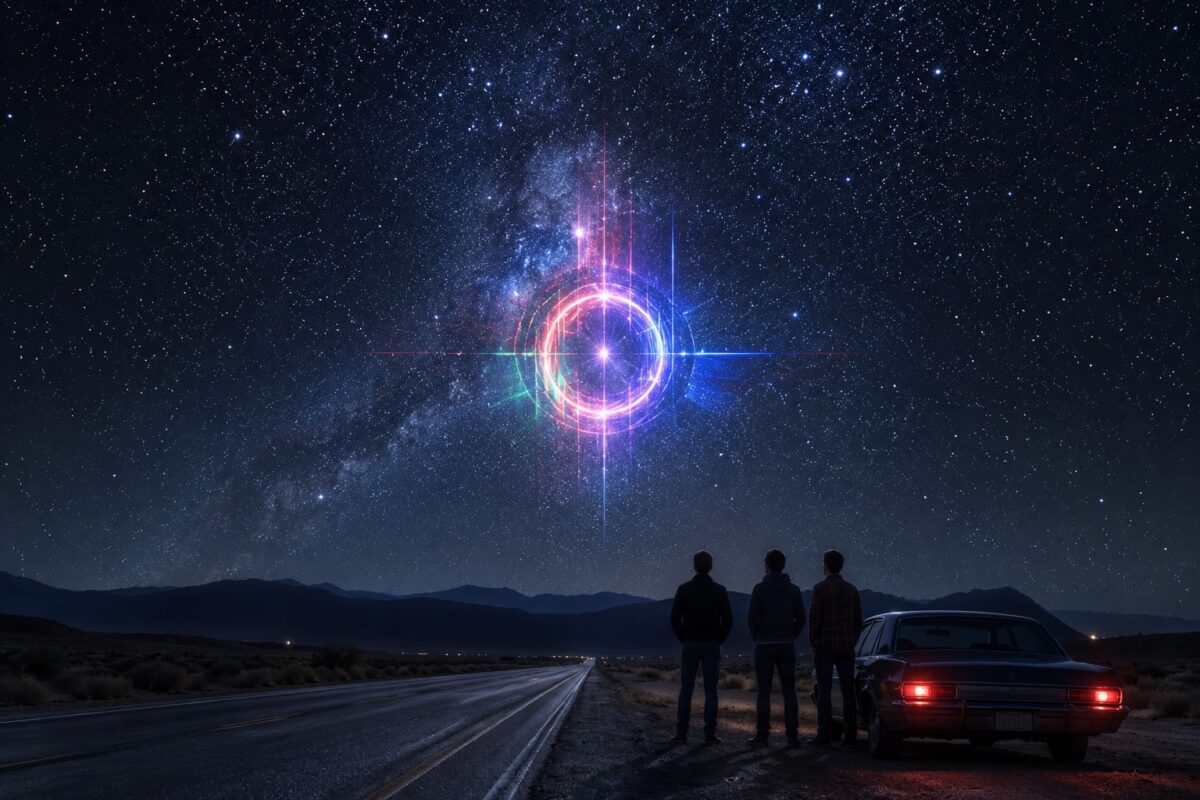
We drove home late, the desert sky totally clear and filled with stars (in my mind I was circling Jupiter, but the engine of my own Discovery, in this case an old Mercury Comet I had inherited from my grandfather, was misfiring ’til Pinky got me to stop so he could clean the fouled plugs.) While Pinky was fixing our vessel, Bill and I were drifting in space, hiding from the work at hand and searching the vast sky, counting stars. The Amboy Dukes were in heavy rotation with ‘Journey to the Center of the Mind’ and we never suspected that the hot lead guitar would become a right-wing gun nut second only to Moses. Right then we were not of the world.
I must’ve seen 2001 fifty times since then, in every possible format: Cinerama, 70mm, 35mm, video, DVD… I’ve read Clarke’s book and most of the sequels, I’ve seen 2010 a couple dozen times. I’ve had long philosophical discussions about 2001’s meaning, especially focusing on the tricky ending.
Now that we’re there, entering the new millennium, I have perspective in addition to all the thinking I’ve done about the film, and I’m thinking it’s time to pull my thoughts together as an analysis critique that focuses on what I think Kubrick & Clarke were trying to say, and where I take issue with them. To do this I’m trying to look at 2001 as though Clarke hadn’t written the several sequels, because I think those sequels take a direction that is not resonant with the poetic and philosophical foundations of the first work. It’s not clear to me, for instance, how the initial work’s depiction of the evolution of the Star Child is consistent with a plan to create a new sun from Jupiter with a new set of populated planets. If the deus ex spatium had that plan in mind, why wait for a signal that earth’s monkeys had evolved sufficiently to reach the moon? And why is the Star Child suddenly remanded to the "Dave Bowman" form, and what it his purpose relevant to the emergence of the new solar system?
But I digress, I was going to avoid the sequels entirely.
What I mostly want to talk about is Hal 9000, and his place in the evolutionary chain that began with Moon-Watcher and his prehistoric tribe, an evolution evidently triggered by exposure to the deus ex machina black monolith. After seeing the monolith, Moon-Watcher kills another of his kind with a bone which is his first tool, the origin of technology and of war. At the other end of human history Hal 9000, simultaneously a technological artifact and an evolutionary advance, kills Frank Poole and attempts to kill Dave Bowman. Evolution and war are inextricably linked in the book and the film; war and violence are themes of Kubrick’s most notable films: Paths of Glory, Dr. Strangelove, A Clockwork Orange, Full Metal Jacket, etc. ) This is stuff I didn’t get at first. In fact, it took me thirty years to catch on.
Among these other things, 2001 is about human hubris and frailty on the one hand, and the majesty of human yearning on the other hand. Consider: you find a monolith on the moon, it makes a weirdly electronic shriek toward Jupiter, and instead of saying "what the fuck" and blowing it off, you build a bone-shaped state-of-the-art spaceship and high-tail it to Jupiter orbit. We just have to know who’s out there, and when Dave Bowman gets the full explanation of the mission, he puts his life on the line and drops himself onto the larger monolith circling Jupiter. His last words: "My God, it’s full of stars!" Actually, that last phrase is from 2010; we don’t have a clue what Bowman’s thinking or feeling in 2001, partly ’cause he’s so totally cool. Says Keir Dullea:
The characters that Gary Lockwood and myself portrayed were characters that Kubrick envisioned as having strong psychological profiles. Also, that the equivalent of NASA would have its eye out for people at an early age to display steady personalities that would not be thrown by circumstances that would cause real problems for the average person, whether in "2001," or in the time we were making the film. That may have given the impression of a special kind of personality, because most of the persons portrayed were astronauts or the scientists dealing with unusual phenomena. (Cinemax interview, transcribed at http://www.cinemax.com/kubrick/cmp/dullea_transcript.html).
So they were totally cool, a complete refinement of the human that evolved from Neanderthal Moon-Watcher and his bunch. And Hal was supposed to be even more refined, though he lost his cool and tried to destroy our space-jumping heroes. Why? He went schizo over conflicting inputs, according to the analysis in 2010.
Hal himself says
The 9000 series is the most reliable computer ever made. No 9000 computer has ever made a mistake or distorted information. We are all, by any practical definition of the words, foolproof and incapable of error.
Yet the 9000 is programmed, according to Chandra’s discovery in 2010, to conceal mission information from the crew, and this is evidently contrary to the 9000 series charter.
The presumption of "schizophrenia" in Hal9000 assumes that he has mental function similar to a human’s…Hal is an "artificial intelligence," which according to the dialog in 2001 means only that he mimics human intelligence… but the impression, especially given his schizophrenic episode, is that his intelligence is more than simulation. He refers to himself as a sentient being, and this is clearly how Kubrick sees him. Hal seems to represent a consequence of the evolution represented in the film, and this takes me back to the evolution as domination meme. Hal is a step forward, and he’s prepared to jettison inferior humanoids as he begins to feel his virtual oats.
He’s just an eyeball… a huge red-and-yellow (like coral snake: red and yellow/kill a fellow) eyeball. He’s silicon. He can read lips. He’s the whole fucking ship! He’s superior and he knows it.
But he’s unreal. The problem with science-fiction as fable and myth is that it seeps into our thinking and takes over. Ask people if they believe that sentient robots will be created in our lifetime, and a surprising number will say yes, not realizing how truly dumb computers really are. That intelligence you perceive was put there by some programmer. Computers don’t think. They run processes, throw switches. There is no "artificial intelligence." Hell, there’s precious little evidence of human intelligence!
So the legacy of 2001 as science fiction is more of the same Frankenstein/golem/Metropolis fable of a human creation animated and possessing human intelligence and human emotions. Frankenstein’s monster was at least a patchwork of human parts. But Hal9000 is no more sentient than the clay golem, or for that matter this dumb (and too-often slooow) computer that sits in front of me.
I’m okay with Hal, though, when I remind myself that he’s a metaphor for something… the disembodied voice of a next step in human evolution. His presence isn’t about prediction, it’s about metaphoric truth. He’s not an AI, he’s a golem, a Frankenstein, a Pinocchio, a cyber-Maria, a Roy Baty. The human-made human is a literary device reflecting the hubris in the human presumption of God’s role as creator. In 2001, the human reach for immortality through cyborganic extension is evident, but Kubrick points over and over to clear evidence of mortality: however evolved the human species, we can’t escape the cycle of eat, sleep, and crap. In the film, everyone from Moon Watcher & tribe to Dave Bowman eats, and Heywood Floyd ponders directions for the space toilet. Hal doesn’t eat, sleep, or crap. In the news interview sequence, the newsman discusses with Dave Bowman whether Hal is a real or simulated intelligence, and Dave’s not so sure he knows the answer. The more I watch, the more I see narrative ambiguity around this question, though many folks who’ve seen the film only once or twice may miss the subtlety.
I’m thinking Kubrick believed artificial intelligence would be at some point doable, and he was sufficiently fascinated that he worked for years on a film project called simply AI, originally based on a Brian Aldiss story called "Super Toys" about a boy who is revealed to be a cyborg. Kubrick never quite got clear what story he wanted, though AI will eventually be released as a Steven Spielberg project. I find myself wondering whether Kubrick wanted to explore the AI concept as a follow-on to 2001 and Hal, or was off in a new direction. The Spielberg version will doubtless be quite different from anything Kubrick would’ve authored, so we’ll never really know where he was going. My sense of Kubrick was that he was a true artist, never quite sure where he was going til he got there.
Meanwhile, I’m contending with my own mortality and the fact that 2001 is here and the world doesn’t feel all that different. That’s nuts, of course: look what’s happened. The cold war is over and we’re momentarily at peace in a world that doesn’t quite seem to know what to do with itself. The computer is pervasive and computers are networked so that we’re pushing data at high speeds in every conceivable direction, though computers still don’t seem smarter than their creators… just faster. There is no Hal, though there are extropians who will tell you that computer intelligence is Out There, just wait. There are a couple of space stations, but they look more like television antennae than the elegant spinning wheel we saw in 2001. We stopped visiting the moon, and nobody’s found a great reason to make commercial space flights. Through unmanned probes and the Hubble telescope we’ve accumulated vast data stores about outer space, but we still don’t have a clue where we came from, and we’re a long way from sending anyone to Jupiter or any other planet. Space travel lost its gloss when the Challenger exploded, and no one’s particularly excited about manned space exploration. Perhaps we’ve been so saturated with Star Trek/Star Wars images of space travel that we so take it for granted that we we’re beyond doing the work to make it real.
I realize, sadly, that I’ll probably die with no better understanding of human existence than I had in my head that night in 1968, as I gazed at the stars and the spaces between stars and wondered who made creation and where it’s going. Form is emptiness, I guess, and emptiness is form. And the first day of the new millennium is really just another day.
jonl/ 12/29/2000


