In my years of drinking beer and talking trash with the late Bill Morton, he seldom wrote letters to me though I wrote many to him. The one letter I did receive was a handwritten transcription of “The Revolution Will Not Be Televised” by Gil Scot Heron, who got the the revolution isn’t in the streets and isn’t in the institutions or legislatures or meeting halls. It’s in our heads.
The Revolution Will Not Be Televised
You will not be able to stay home, brother.
You will not be able to plug in, turn on and cop out.
You will not be able to lose yourself on skag and skip,
Skip out for beer during commercials,
Because the revolution will not be televised.
The revolution will not be televised.
The revolution will not be brought to you by Xerox
In 4 parts without commercial interruptions.
The revolution will not show you pictures of Nixon
blowing a bugle and leading a charge by John
Mitchell, General Abrams and Spiro Agnew to eat
hog maws confiscated from a Harlem sanctuary.
The revolution will not be televised.
The revolution will not be brought to you by the
Schaefer Award Theatre and will not star Natalie
Woods and Steve McQueen or Bullwinkle and Julia.
The revolution will not give your mouth sex appeal.
The revolution will not get rid of the nubs.
The revolution will not make you look five pounds
thinner, because the revolution will not be televised, Brother.
There will be no pictures of you and Willie May
pushing that shopping cart down the block on the dead run,
or trying to slide that color television into a stolen ambulance.
NBC will not be able predict the winner at 8:32
or report from 29 districts.
The revolution will not be televised.
There will be no pictures of pigs shooting down
brothers in the instant replay.
There will be no pictures of pigs shooting down
brothers in the instant replay.
There will be no pictures of Whitney Young being
run out of Harlem on a rail with a brand new process.
There will be no slow motion or still life of Roy
Wilkens strolling through Watts in a Red, Black and
Green liberation jumpsuit that he had been saving
For just the proper occasion.
Green Acres, The Beverly Hillbillies, and Hooterville
Junction will no longer be so damned relevant, and
women will not care if Dick finally gets down with
Jane on Search for Tomorrow because Black people
will be in the street looking for a brighter day.
The revolution will not be televised.
There will be no highlights on the eleven o’clock
news and no pictures of hairy armed women
liberationists and Jackie Onassis blowing her nose.
The theme song will not be written by Jim Webb,
Francis Scott Key, nor sung by Glen Campbell, Tom
Jones, Johnny Cash, Englebert Humperdink, or the Rare Earth.
The revolution will not be televised.
The revolution will not be right back after a message
bbout a white tornado, white lightning, or white people.
You will not have to worry about a dove in your
bedroom, a tiger in your tank, or the giant in your toilet bowl.
The revolution will not go better with Coke.
The revolution will not fight the germs that may cause bad breath.
The revolution will put you in the driver’s seat.
The revolution will not be televised, will not be televised,
will not be televised, will not be televised.
The revolution will be no re-run brothers;
The revolution will be live.
“That was about the fact that the first change that takes place is in your mind. You have to change your mind before you change the way you live and the way you move… the thing that is going to change people is something that no one will ever be able to capture of film… it will just be something that you see, and all the sudden you realize, I’m on the wrong page, or I’m on the right page but on the wrong note, and I’ve got to get in sync with everyone else to realize what is going on in this country.”
Jasmina Tesanovic posts about the arrest of Ratko Mladic here.
As a further financial twist, the state still owes the general his regular pension, which he never received (as a fugitive). Handsome lump-sums have paid by and to the other citizens of the state — mainly, blood money for his victims.
And what about the dead? Do they have a price? Gone without a name, many of them still without graves since their bodies, dismembered and scattered all over the territory are still being sought. The silence of the ghosts is loud as ever in this moment of joy and victory.
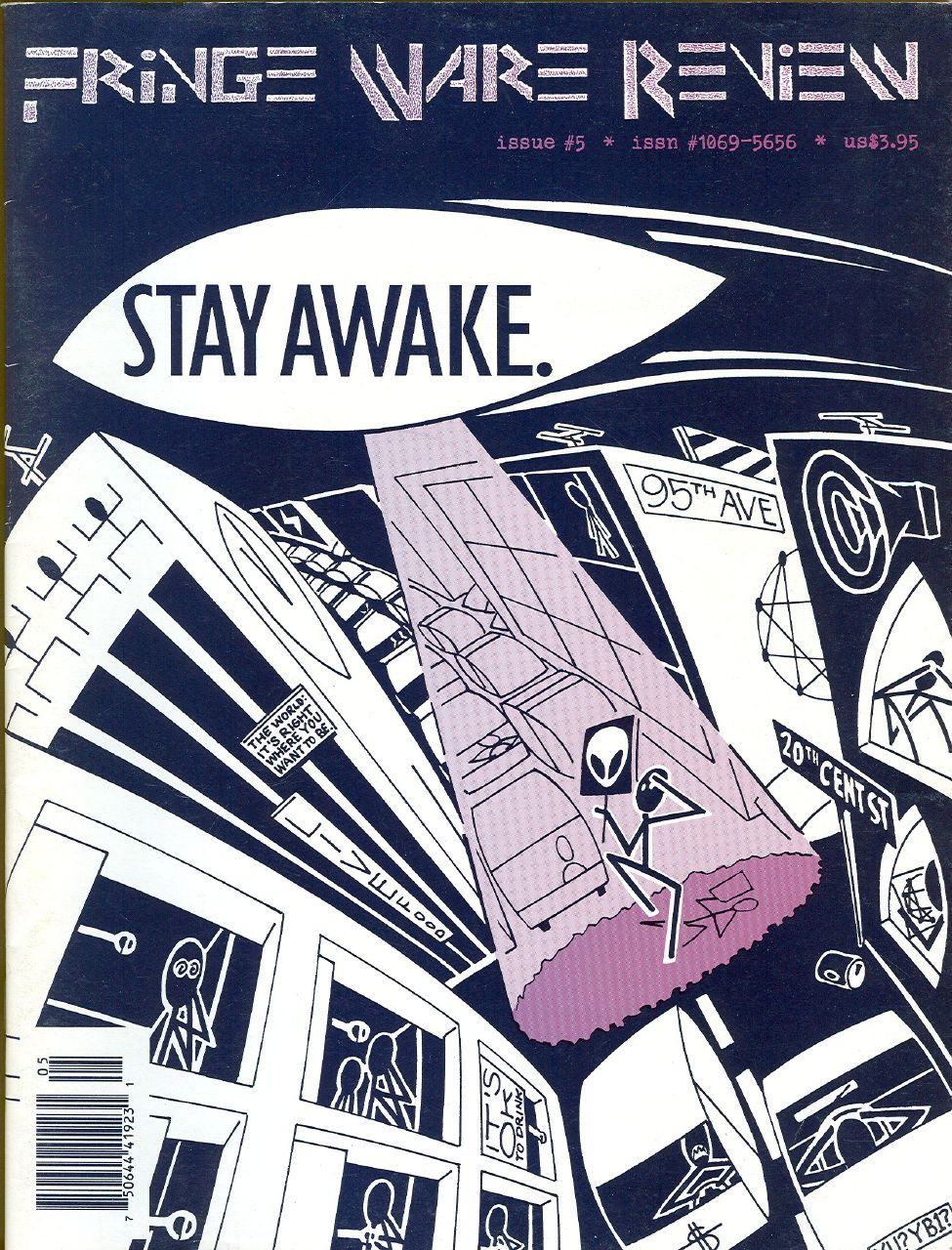
Here’s another older piece, my zany editorrant incroducing from Fringe Ware Review #5, the “Stay Awake” issue.
This issue of Fringe Ware Review was originally called the ‘alien invasion’ issue; our original intention was to create a sometimes serious, sometimes parodic hash of Bill Barker’s schwa, UFO theory, and cultivated paranoia for the 90s. However yer humble editor kept hanging on Barker’s stark sanserif STAY AWAKE! Though components of my alien invasion kit have never flashed red in the phenomenal world, this slogan flashes red, with sirens, every day in my consciousness, a reminder that I’m really not. Awake, that is.
Though something of an attention- deficient dilettante, I’ve focused on and returned to two similar paths throughout my life. One is the Buddhist ‘Middle Way,’ the other is Georges Gurdjieff’s ‘Fourth Way.’ I know abysmally little about either, yet they still resonate within, and I always say that someday I will get wise to these paths and start walking, wide awake. It hasn’t happened yet, and it may never…but the vibe is there, and it struck me while preparing for this issue:
We have to include something about Gurdjieff.
This ain’t easy. Folks who study Gurdjieff’s teachings are a bit reticent, not because they don’t want to tell, but because it’s nearly impossible to explain the Gurdjieff work since an understanding requires a knowledge base that most folks lack. We knew Gnosis had devoted an issue to Gurdjieff, so we asked publisher Jay Kinney for guidance. He referred us to John Shirley, a writer usually associated with cyberpunk sf, and John created the powerful piece included in this issue. And we received other submissions in the same vein. Our contributors seemed to find Gurdjieff and consciousness alternatives more compelling than UFOs, though we did also receive some UFO stuff.
In ye ed’s mind, there was some weirdness brewing. Having just completed work editing the States of Mind section of The Millennium Whole Earth Catalog, we were tuned into current thinking about consciousness and consciousness technologies. We were reading John Mack’s book, Abduction, and we were thinking a lot about Brian Wilson of The Beach Boys. Somehow all this stuff worked together.
There are two ways to approach the Beach Boys, the first of which is pretty much dismissive of their smiley-face beach party hotrod music as the crewcut-clean sorta MOR rock that, well, Nancy Reagan might like to hear (she defended their selection to play one 4th of July in Washington when James Watt wanted to put ’em out). This is a response to the Mike Love model of the Beach Boys, and it’s valid. But there’s a whole other thing about the Beach Boys, and it’s really about Brian Wilson and to some extent his brother, the late Dennis Wilson. The Wilsons were sons of Murry Wilson, and for many years they were his meal ticket. Murry was real, and he was crazy: no Father Knows Best model here, this was a guy who could jump naked on the kitchen table, beat his chest, and proclaim his position as king of the house. When you read Brian Wilson’s biography, you find just this bizarre kind of shit…and you learn that, while much of the world saw the Beach Boys as essential pop effervescence, their creative fountain Brian was Losing His Mind. He was eating unimaginable combinations of drugs, living a sort of catatonic existence, his creative powers waning… And his brother Dennis, the one Beach Boy who actually hit the surf with a vengeance, was getting pretty screwed up, too…eventually drowning, evidently while under the influence of god nose what diversity of brain- whacking chemicals. The contrast between the lives of Brian and Dennis on the one hand, and the Beach Boys image on the other, is what interests me most about the Beach Boys. Brian made lush, incredibly beautiful music, yet his life was shit. The average person cruising down the boulevard hearing distant strains of ‘Good Vibrations’ and smiling recognition gets but misses the essence of the music…the essence is to make you smile, yes, but the essence is also anesthetic: it’s that postwar denial that took America in the 50s and never quite went away…it’s like sleeping through painful surgery. Technicolor, stereophonic sound, immersive entertainments like Cinemascope, Cinerama, etc…or television’s soft secure glow from a corner of the room. Better: a transistor radio playing tune after tune & commercial after commercial as you drift to sleep… You are not awake. Someone has your brain locked. Remain where you are. Do not resist. Give or do whatever they ask. Forget everything that happens.
UFO abductions seem real as anything when you read John Mack’s accounts of interviews with abductees, when you see video of abductees talking about their experiences and the impact on their lives…it’s tougher and tougher to deny the reality of these strange invasions. From the descriptions, it appears that we’re living on the farm. That’s the good news; the bad news is that we’re the livestock! Breeding stock, that is. “They” seem to be swiping semen from our males, and implanting our females with hybrid creatures, part alien, part man. Guess they’ve been doing this since the first monkey-man…was he developed? Sheesh. This would blow gaping holes in the anthropocentric philosophical constructs that glue self together, it would be like blowing the foundation of the temple constructed from western materialistic philosophy…we approve! So we’ve been invaded, so we’re chattel: what’s new? Any one whose brain’s been sucked dry by the political and bureaucratic machines of states and corporations in the premillennial world has been invaded, colonized, farmed if only for ox-labor. (John Mack actually theorizes that this ‘hybridization’ project, if it exists, has a different purpose “that serves both of our goals, with difficulties for each.” Though alien invasion/abduction is an effective metaphor for the human practice of brainsuck exploitation, we won’t pretend, assuming that these aliens exist, that we know what they’re up to. We’ll try to stay awake, though, ’til we understand the incomprehensible….)
One of Mack’s abductees, quoted late in the book, sez “Something else is interested in us that we don’t want to know about. This is happening. It’s not just a happy little dream where you can feel like you’re important. This is really a responsibility, and things that you don’t want to see happen are going to happen.” Though abductees seem to bury memories within layers of memory that most of us don’t touch, they’re retrieving them now, and as they retrieve them, they drop the prevalent cultural attitude of denial and begin to WAKE UP. What are they waking to? Mack says “With the opening of consciousness to new domains of being, abductees encounter patterns and a design of life that brings them a profound sense of interconnectedness with the universe.” Does this differ from Buddhist perception, or from the subtext of the Gurdjieff work? Since I’m a dilettante, I can’t really answer from experience, but it seems intuitively right. There’s an evolution now, and it’s happening on the fringes beyond denial. It doesn’t matter whether you believe in alien abduction, UFOs, satori, nirvana, the devil, the deep blue sea, the SubGenius, or the Perfect Wave: it’s not what you believe, but how you exercise your consciousness that’s important.
In Buddhism, and possibly in 4th Way, gnostic Christianity, etc. there’s little debate about god…’god’ is an edifice we’ve built within our collective unconscious to represent the unknowable, and since it’s unknowable, it’s beyond the scope of our concern. Instead we focus on the only reality, that which is here and now, and we see process and change for what they are: uncertain, unfathomable. We find solace not in theistic or materialistic fantasies, but in community. Brian Wilson, damaged, alienated, was trying through his music to create an essential harmony that he’d lost, or possibly never known…though he never surfed he was looking for that perfect wave.
In the 1990s, with the Millennium approaching, so many of us who surf the fringes, within ‘cyberpunk’ or other alternative scenes, are working through a kind of disillusioned cynicism; our heroes have screwed the proverbial pooch and we’ve seen the human failings within everyone and we’ve seen the sleazy corruption at the core of our institutions and we’ve seen exploitation at the heart of our corporate structures and this is our life. In the 60s, when we had an early sense of the contradiction between the American middle-class fantasy of whiter whites and bluer blues and the intense suffering within our own ghettos and the ghetto nations of the world, we built an underground that merged with what we’d once called the death culture, and we acquiesced, hiding within air- conditioned nightmares across spaceship earth as it spun out of control. We were inoculated by daily doses of blandscrew representations of ‘news’ so that we could somehow ignore the content of the suffering described by the anchors and the correspondents and the victims-on-scene. If you read an account of this world in a science fiction novel, you’d say to yourself, I’m glad the world’s not like that, but it is! So what do you do?
If you can’t save the world, save the neighborhood. This is similar to think globally, act locally, but with stronger reference to human interdependence. Ignore geographical constraints and make community wherever and however you can, i.e. plug into a network of folks with whom you have affinity, and support your friends. Ignore the established culture, which creates market blocs where there should be neighborhoods, which creates tightly controlled, highly manipulative mall environments where there should be interactive street markets. Above all, Stay Awake! Don’t allow the most truly alien and dangerous forces (churches, politicians, corporate propagandists) to colonize your mind and steal your soul. It’s helpful to take an inventory that includes you and all your possessions, and consider what they can and can’t take from you. They can’t take your mind, and they can’t take the moment…
As for the aliens and their UFOs, well, we’re still watching and waiting. But meanwhile we’re looking for something else, too, the right kind of surf, the right vibration…
Stumbled onto this piece I wrote in 1994 for FringeWare Review, triggered by a meeting with Hans Moravec, as I recall.
Robotics has two sides — real-world practical application and development, and scifi mythopoetic phantasy construction — and like most real/surreal dichotomies of the Information Age, these two sides are blurred and indistinct within human consciousness, whatever that might be….
A good question in this context: What is consciousness? This is hard to answer because of the obvious blind spot inherent in self-definition (conscious process defining consciousness), you can’t see the forest for the trees or the neurons for the nerves, as the case may be. Because the “conscious” part of me is as deep as I usually go, or as I need to go in order to play the various survival games, I tend to confuse consciousness, an interface between the internal me and the external “thou,” as the totality of my being, as a real thing rather than a conveniently real-seeming process. (Then again, if consciousness defines reality, what’s real is what consciousness says is real, but that’s a digression….)
The sages tell me I’m delusional (attached to the delusion of samsara, of the world, in the Buddhist view), but I can’t quite figure out what this means. That’s because “I” am as much the noun, delusion, as the adjective, delusional. So much of what I am is filtered out, inaccessible to the ego-interface.
But wait. The delusional “I am” is a convenience that facilitates individual survival-stuff, so I’m not dissin’ it. The purpose of this rant is to make a point, not about ego or delusion (I’ll let the sages stew in those juices), but about robotics and AI research and the belief, often expressed in both scifi and real-world contexts, that you, or more precisely “your consciousness,” can be stored digitally. In most scifi depicitons of “consciousness in a box,” the object is immortality: you store what’s essentially you, and it “lives” forever, or until the plug’s pulled, whichever comes first (I know where I’m putting my money). In scifi, this is just another device for exploring the question of immortality, which has fascinated scifi authors and the mythmakers that preceded them as a way to come to terms with the death thing. Trying to rationalize the inescapable. But you find other optimistic folks (Hans Moravec, the Extropians) who are quite serious about the potential for immortality and who consider the consciousness-in-a-box scenario a viable means to that end.
I have a couple of problems with the scenario, myself, the first being that, even if you digitized your consciousness and stored it in a psychoelectronic device of some kind, it would not be you. Your awareness would still fold when you discorporate; the thing that’s stored might emulate your thinking or even your behavior, but it would be a simulacrum, like you but not you.
The other problem I have is best expressed in the form of a question: What are we storing? There seems to be a confusion between process and object. If consiousness is indeed only a shallow process handling the various negotiations between what we call subconscious and external reality, what is the character of the data you’re uploading and defining as you. Rules, implementations, stored memories — consciousness is really a hash consisting of no single, store-able entity. It’s like trying to package a tornado — what do you put in the package? Do you include all the chaotic elements of weather formation and all the applied physical rules that are manifest in the tornado’s brief life span as a process event?
The bottom line here is that you can’t really isolate a single entity “consciousness” and divorce it from its generative context.
Can you even simulate consciousness? Or intelligence, which probably has a clearer rule base than the vaguer concept of consciousness, but is still elusive. An “artificial” intelligence with sufficient density and complexity to mimic human consciousness is the very real goal of a particular thread of applied research, but so far no digital simulacrum has been constructed that “thinks” as we know thinking. The problem here resonates with the earlier argument about stored consciousness: we don’t have clarity about the definition and composition of human consciousness, so how can we copy it? It’s hard enough to copy something we know.
The mythic representations of scifi robots like Robbie or Gort or Hal9000 are like consciousness in a black box, deus-ex-machina stuff that might serve to carry a plot forward but, to those who punch code into dumb processors day after day, doesn’t ring any more true than a fairy tale or myth, which is to say that it’s more about wishes and fears than about any current or projected reality. It’s one thing to load a few rules, even with algorithms to simulate heuristic process, into the CPUs of this world, but it’s a real stretch to conceptualize silicon-based thinking or awareness.
Human and animal consciousness are products of code generations and modifications that reach `way back, perhaps to the inception of the universe, and are driven by an unfathomable creative force compared to which our efforts to construct artificial minds seem comparatively short-sighted and pitiful. Then again, I suppose in our efforts to mimic “the gods” we’re channeling that creative force, whatever its true origins, because it must be inherent in the coce structure of the human genome. And if that’s so, perhaps we’re destined to coevolve with our own creations, which have themselves evolved from basic practical and conceptual tools to today’s ubiquitous computing systems. This coevolution may produce cyborganic life forms which, though not created entirely by our hands, may be seen as products of an obsessive desire to be as we imagine gods to be, creatively self-perpetuating and therefore, as a race if not individually, immortal.
I’ve been in conversation with a diverse group of people who are interested creating a next version of the Internet that’s more peer to peer, more open source/open architecture, less vulnerable to government or corporate restriction. Some aspects of the various threads of conversation are idealistic – not wholly unrealistic, but so far a bit fuzzy and not fully baked. However there’s substantive, useful, and promising discussion in the air, and I’m hopeful that something viable and helpful will emerge.
Coincidentally, the concept of emergence came up, via this article by Margaret Wheatley, who calls emergence “the fundamental scientific explanation for how local changes can materialize as global systems of influence” as networks evolve into communities of practice, and then systems of influence begin to emerge. This she calls the life cycle of emergence.
This resonates with the Emergent Democracy discussion and paper that Joi Ito, Ross Mayfield, and I (along with several others) worked on in the early 2000s. But what’s missing in this talk about emergence and changing the world is the role of intention. Who sets the goals for changing the world? Who catalyzes networks and drives them in a particular direction? No person or group decides to make something emerge or to make specific changes – emergence is about force and evolution, not human intention. And when you talk about changing the world, by whom and for whom, and with what force, become relevant questions.
The Tea Party and the Koch Brothers want to change the world, too. Is their vision less valid than mine or yours?
But there are forces that transcend Internet theorists and instigators, Tea Parties, partisan movements, idealistic next-net theorizers, rebels in the street, corporations, governments, etc. – forces that emerge out of control; evolution that occurs, not created or driven by some interest group, but driven by complex social physical, psychic, and social factors that have unpredictable effects.
We’re just another set of smart people who think we know how the world should work, and we probably need more humility. How can we be effective in a context where there are forces that are truly beyond our control? What intentions should we support and honor?
EFF-Austin has been quietly working along presenting occasional events (like the recent Texas Government 2.0 Camp), operating its email list, and publishing occasional blog posts, but we’ve had a growing sense of a need to ramp up our activities. We can see major threats to the distributed, decentralized Internet and the expectation of a “freedom to connect,” and there are all sorts of interesting conversations and movements emerging that are relevant to EFF-Austin’s stated mission: “EFF-Austin advocates establishment and protection of digital rights and defense of the wealth of digital information, innovation, and technology. We promote the right of all citizens to communicate and share information without unreasonable constraint. We also advocate the fundamental right to explore, tinker, create, and innovate along the frontier of emerging technologies.”
A first important step in our ramping up: we’re restarting our monthly meeting series, coordinated by our new board member, Anna Kozminski. The first of the new series of meetings is June 1 at the Flying Saucer at the Triangle – information and (free) registration here. Open Source software developer Tom Brown, who among other things maintains oscurrency for the Austin Time Exchange and founded Superborrownet, Inc., will talk about his experience attending Internet Identity Workshop 12, and about the Identity Commons movement in general. Come to the meeting, express your support for EFF-Austin’s mission, volunteer to be part of our future going forward.
(Note that EFF-Austin is an independent nonprofit formed originally as a potential chapter of the national Electronic Frontier Foundation (EFF). When EFF decided not to have chapters, we went our own way as an influential organization focused on cyber liberties and more, such as digital culture and arts.)
Osama bin Laden’s death is a complex event with many implications and potential repercussions, yet it’s been trivialized by media analysis (professional and social) that avoids going deep and focuses only on its meaning in the context of the 2012 campaign, or as Adam Hochberg notes, “just another lap in the political horserace.” Another Hochberg point that bears repeating: “…the Internet has removed the traditional filters and allowed the public
to immediately see and participate in Washington’s constant political
posturing.”
Doc Searls has posted a slideshow explaining how Amazon’s user experience is broken, in the context of a discussion about vendor relationship management (VRM), which is about evolving a world where customers have at least symmetry in the power relationship of customer and vendor. The slides are old (January 2010) and things might have changed, but I don’t think they’ve changed as much as they should’ve, because I still experience similar frustrations when I visit Amazon.
This talk by Eli Pariser reminds me of discussions with David Weinberger about online echo chambers. I recall that this came up as social technology became part of the political process in ~2004. I’ve been concerned that the polarization we’re seeing in the U.S. and elsewhere is exacerbated if not caused by our tendency to pay all of our attention where we agree, and none of it where we’re challenged by opposing or new ideas.
When Mitch Ratcliffe and I published Extreme Democracy in 2005, the question came up whether the discussion of politics and social technology was technoutopian. Without getting into the specifics of the book (which included diverse articles, some more positive than others about the potential role of what we now call social media in our political life), I can say that I rejected the “technoutopian” label as a rather shallow dismissal of a complex question: does a technology that gives everyone the potential to have more of a voice bring us closer to a democratic ideal? Or does it turn up the noise and overwhelm the signal? Or could it do both?
I thought about this after reading Cory Doctorow’s piece about the general question of technology optimism vs pessimism. Cory says that he’s a techno-optimist, but note that his position embodies both optimism and pessimism: ” the concern that technology could be used to make the world worse, the hope that it can be steered to make the world better.” He has a great example:
To understand techno-optimism, it’s useful to look at the free software movement, whose ideology and activism gave rise to the GNU/Linux operating system, the Android mobile operating system, the Firefox and Chrome browsers, the BSD Unix that lives underneath Mac OS X, the Apache web-server and many other web- and e-mail-servers and innumerable other technologies. Free software is technology that is intended to be understood, modified, improved, and distributed by its users. There are many motivations for contributing to free/open software, but the movement’s roots are in this two-sided optimism/pessimism: pessimistic enough to believe that closed, proprietary technology will win the approval of users who don’t appreciate the dangers down the line (such as lock-in, loss of privacy, and losing work when proprietary technologies are orphaned); optimistic enough to believe that a core of programmers and users can both create polished alternatives and win over support for them by demonstrating their superiority and by helping people understand the risks of closed systems.
On the question of democracy, I feel an optimism that we can have better transparency and more participation through the Internet-based technologies we’ve created, and are still evolving. Certainly more people are engaged in conversations about politics and the ideas that inform political action. However I have worrisome concerns. One is that too many voices in the mix, too much commitment to consensus, can stall or prevent effective action in governance, and we have too many critical problems to be stalled.
I’m also concerned that “the will of the majority” is not necessarily guided by intelligence, and that it can be manipulated by effective propaganda, such as self-serving well-orchestrated astroturf email and blog campaigns founded on a memetics of fear, uncertainy, and doubt – the “birther” phenomenon is an example of this.
In my last post I mentioned the possibility of an Open Source party that leverages the kind of thinking about organization and action that has emerged from projects based on what Benkler calls commons-based peer production, “in which the creative energy of large numbers of people is coordinated (usually with the aid of the Internet) into large, meaningful projects mostly without traditional hierarchical organization (and often, but not always, without, or with decentralized, financial compensation).” I’m feeling cautiously optimistic about this idea; will be exploring it further… I’m clearly pessimistic that the current direction of politics is sustainable, so it’s time for new ideas and experimentation.
I just sent the following to an email list I’m on, and thought it would be worth sharing here:
I’ve been involved with R.U. Sirius in instigating an International Open Source Party (version 2.0 – we tried it before but it didn’t quite launch). He wrote about it here: http://hplusmagazine.com/2011/02/24/open-source-party-2-0-liberty-democracy-transparency/ This article includes the principles I came up with for Open Source politics, which I include below. Open Source is not a religion, i.e. not based on faith in something that can’t be observed or experienced. It’s about transparency: when we apply the term Open Source we’re talking about following methods and processes in production and distribution such that whatever we define as “source code” can be observed and experienced, so to me it’s the opposite of religion. Eric Hughes once explained to me, when I was new to Open Source thinking, that a particular encryption tool should be Open Source so that its source could be examined and its effectiveness and integrity verified. Politics should be like this, and if we all insisted on this approach, religion would be transformed into practice (a la Buddhism and 4th Way) rather than dogma (a la much of Christianity).
Principles of Open Source Politics:
Openness
Many of us who are tech-focused have come to understand the power of open approaches and open architectures. Even technologies that aren’t strictly “Open Source” benefit from Open APIs and exposure of operating code (kind of inherent with scripting languages like Perl and PHP). When we know how something works, we know how to work with it. And we know how to transform it to meet our needs.
Government should be as open and transparent as possible. There may be some rationales for closed doors, but few — for the most part, citizens should be able to clearly see how decisions are made. That’s a key component of our political platform: we want to see the actual “source code” for the decisions that affect our lives.
Collaboration
Open Source projects are often highly collaborative and can involve many stakeholders, not just manager and coders. The Open Source Party sees this as a great way to do government. (I’m partial to charrette methodology, personally.)
Emergent Leadership
Effective action and decison-making requires leadership. In an Open Source form of politics, leaders emerge through merit -— by providing real leadership and direction, not by appointment, assignment, or election. Nobody made Linus Torvalds the lead for Linux, or Matt Mullenweg the lead for WordPress. They saw a need, created a project, and found an effective following who acknowledged their vision, expertise, and ability to manage and lead. Emergent leaders aren’t handed authority. They earn it, and if they cease to be engaged or effective, they pass the baton to other leaders who emerge from within the group.
Extensible and Adaptable
Open Source projects and structures are agile and malleable. They can be adapted and extended as requirements changed. Governance should have this kind of flexibility, and our system of governance in the U.S. was actually built that way. We should ensure that bureaucracies and obsolete rule sets don’t undermine that flexibility.
Read Jasmina’“Big Day for Italy”: Living in Torino, Jasmina is not far from the beatification ceremonies for Pope John Paul II – a Serbian journalist writing about the Italian response to a Polish pope, now sainted, just a couple of days after the UK pompfest royal wedding. A global culture celebrates traditions that won’t quite go away. Meanwhile for May Day the “politically excluded” took to the Italian streets “with banners of feminists, pacifist, trade unions, unemployed, refugees, minorities etc…clearly stated their distance from empty Unity of Italy celebrations, not to mention the deceased Pope.”
Three different Italies, today in Italian city squares: the Nation, the Church and the Populace, all protesting, stating, showing, claiming and counterclaiming. Like 150 years ago when this young nation was united under one flag and a royal anthem, drenched in blood amid many uncertainties, today too, the classic Italian scenario repeats itself, as a farce of course.
Facebook took down Ars Technica’s page on the site because of allegedly infringing content. Read about it here. The page is back after much wrangling. The problem for Ars Technica (and potentially for anyone else against whom there’s an infringement complaint) was that Facebook didn’t tell them what content was allegedly infringing or offer them an appeals process or an option to remove the content. Evidently Facebook didn’t think through a process for handling these complaints, which can easily be bogus.
I’m not an attorney (so don’t take my word for this), but I can suggest a process: the DMCA says Facebook should promptly block access or remove the material, so they really have to do something. My process would be to block the page temporarily, notify the page owner of the complaint and specify the content, give them an opportunity to take the content down or make the case that it’s not infringing. The Online Copyright Infringement Liability Act says that the counter-notification from the page owner saying that the material is not, in face, infringing would be enough for safe harbor from liability.
Burkhard Bilger in The New Yorker profiles David Eagleman, a brilliant researcher who’s studying the brain, consciousness, and the perception of time. At a personal level I’ve spent a lot of time in recent years studying and trying to comprehend my own degrees and levels of consciousness and perception. We think of our “conscious experience” as a constant, and our unconscious as inaccessible… but through attention we learn that there are gradations in the range of conscious to “un-” or “sub-” conscious experience; that perceptions can vary with context; that memory is selective and undependable; that our perception of the world is generally incomplete though we do a good job of filling the gaps. When David Eagleman was a child he fell from a roof and realized that his perception of time had changed as he was falling. Now he’s doing evidence-based research to determine how people experience the world, what are the variations, how does the brain work and how does the mind work? Read about it here. If you know about similar studies and writings, please post in comments.