Wikileaks is a big deal; Mark Pesce’s written the most insightful comment I’ve seen yet explaining just why. Read it here.
Everything is different now. Everything feels more authentic. We can choose to embrace this authenticity, and use it to construct a new system of relations, one which does not rely on secrets and lies. A week ago that would have sounded utopian, now it’s just facing facts. I’m hopeful. For the first time in my life I see the possibility for change on a scale beyond the personal. Assange has brought out the radical hiding inside me, the one always afraid to show his face. I think I’m not alone.
Video archive of Saturday’s Wikileaks discussion, which was quite compelling… quite a bit about the new world of journalism and Wikileaks’ place in it. These are truly chaotic and “interesting” times.
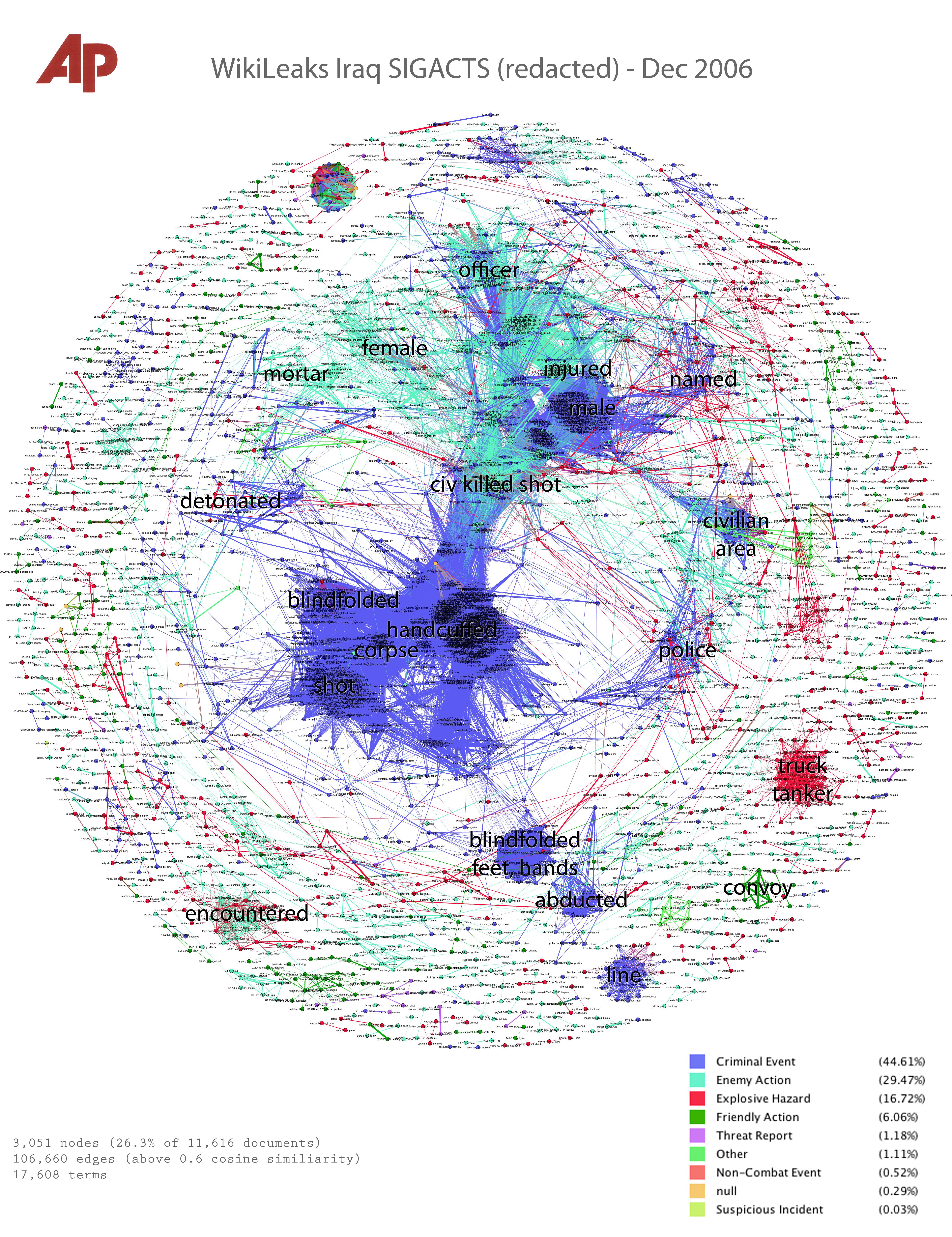
Stray and Julian Burgess created a visualization using data from December 2006 Iraq Significant Action (SIGACT) reports from Wikileaks. That was the bloodiest month of the war, and the central (blue) point on the visualization represents homicides, i.e. clusters of reports that are “criminal events” and include the word “corpse.” These merge into green “enemy action” reports, and at the inteface we have “civ, killed, shot,” civilians killed in battle. Stray tells how this was done, with some interesting notes, e.g.
…by turning each document into a list of numbers, the order of the words is lost. Once we crunch the text in this way, “the insurgents fired on the civilians” and “the civilians fired on the insurgents” are indistinguishable. Both will appear in the same cluster. This is why a vector of TF-IDF numbers is called a “bag of words” model; it’s as if we cut out all the individual words and put them in a bag, losing their relationships before further processing.
As a result, he warns that “any visualization based on a bag-of-words model cannot show distinctions that depend on word order.” (Much more explanation and detail in Stray’s original post; if you’re interested in data visualization and its relevance to the future of journalism, be sure to read it.)
Thanks to Charles Knickerbocker for pointing out the Stray post.
Plutopia Productions projects are on fire… including the Plutopia 2011 event during SXSW and the Plutopia News Network that Scoop Sweeney and I will be launching within the next month. Scoop and I are also producing events on the side, like last Friday’s “From Jerusalem to Cordoba” performance by Catherine Braslavsky and Joseph Rowe. Scoop and I, like our Plutopia Productions colleagues, see event production — creating compelling experiences — as an art form. We expect to produce at least one event per quarter, either as part of Plutopia Productions or onw our own, in addition to our work on the content site, which will include podcasts and god nose whatever other media.
I’m partnering with other web developers in creating Teahouse Media, a web consulting and development cooperative. Web development is my day job, and I pursue it with relish… an avid builder of information environments and systems. As in the past, I’m focused on open source platforms, primarily Drupal and WordPress.
With a loose group journalists and other thinkers and doers, I’ve been exploring the future of journalism and the emergence of digital news applications; set to moderate a panel on the subject at SXSW Interactive.
Trying to get my head aorund the future of the Internet. I gave a talk on the subject at a recent meeting of the Central Texas World Future Society, and will give another similar talk at Link Coworking at noon on January 8.
In that context, I’ve also been tracking the Wikileaks controversies, thinking to convene a public forum on the subject via EFF-Austin. Is Julian Assange shouting “fire” in a crowded theatre? Or is he a contemporary Daniel Ellsberg variation? Also thinking about transparency; working as an organizer (with the LBJ School) of the Texas Government 2.0 Camp, which will be January 28-29.
A practicing Buddhist, I’m looking into the Gurdjieff work, a different system of thinking, but similar in its cultivation of mindfulness. True mindfulness is easy to conceive but hard hard hard to achieve.
I’ve signed up to be a reviewer for the City of Austin’s Grant for Technology Opportunities, which awards money to community technology projects. I’ve always had an interest in community technology, and that’s revived somewhat as I note that there’s still a digital divide, and it’s even more significant as so much more of what we do in our daily lives requires access to technologies and networks. Also interseted in digital literacy; not long ago Howard Rheingold and I were discussing his next book, which will be on that subject.
The world is incredibly screwed up at the moment; I feel an obligation to get into an active an visible advocacy for the things I think are important… a humane progressive agenda, a positive and transformative cultural agenda, depolarizing politics and an end to the cultural cold war in the U.S. and beyond, commitment to the ideal of sustainability, acknowledgement of and response to the problem of global warming, etc. Can a web developer do all that much? I’m with the army here… we should all try to be all that we can be…
View a triking set of photos from the National Geographic Photo Contest. Galleries here. These photos reminded me that the world is so much larger than my Twitter account…
It’s crazy time in the world at large, a time of social, political, and economic chaos and a questioning of fundamental assumptions we’ve made about how the world works and doesn’t work. You can blame the “interesting” difficulties we’re in on shortsighted politicians, greedy bankers and corporations, god-mad religious fundamentalists, exploding and fragmenting communications… and I’m sure those and others are aspects of the Trouble. But I think we have a deeper problem. We’ve lost our sense of the common ground of humanity, of the pattern that connects us all.
This is too often said and too easy to say: in a profound sense we are united at the core, but we lose the sense of unity, and see only what divides us. How can we feel this truth in our bones? How can we find a way past the significant and growing barrier and borders, the sense of separation that we feel?
Perhaps we can find the common ground through music, a form of communication that can be a common language and source of unity. “From Jerusalem to Cordoba,” a performance Scoop Sweeney and I are producing Friday night (7pm at St. David’s Church, Bethell Hall, 301 E. 8th Street in Austin) is a powerful musical performance by Catherine Braslavsky and Joseph Rowe that includes songs and forms associated with both Christian and Muslim mystical traditions. Behind the music, there is an understanding of the common ground of humanity. In this music, there is a possibility of peace, a sense of our shared source and reality.
In my obligatory post about Wikileaks as the story du jour, I point to the great set of questions Dan Gillmor has posted in his column at Salon. These are especially lucid. I like especially Dan’s point about the character of the communications that were leaked, that many of the messages are gossip. Journalists are dutifully reporting “facts” gleaned from the leaked material without necessarily digging deeper, verifying and analyzing. Of course, they don’t have time – the information environment moves too quickly, he who hesitates is lost, accuracy be damned.
Then again, journalism is so often about facts, not truth. Facts are always suspect, personal interpretations are often incorrect, memories are often wildly inaccurate. History is, no doubt, filled with wrong facts and bad interpretations that, regardless, are accepted as somehow “true.”
The high-minded interpretation of this and other leaks, that people need to know what is being said and done by their representatives in government, especially in a “democratic society,” is worth examining. We’re not really a democracy; government by rule or consensus of a majority of the people doesn’t scale, and it would be difficult for the average citizen to commit the time required to be conversant in depth with all the issues that a complex government must consider.
Do we benefit by sharing more facts with more people? (Dan notes that 3 million or so in government have the clearance to read most of the documents leaked – this seems like a lot of people to be keeping secrets… is the “secret” designation really all that meaningful, in this case?) But to my question – I think there’s a benefit in knowing more about government operations, but I’m less clear that this sort of leak increases knowledge vs. noise.
I’m certain about one thing: we shouldn’t assume that the leaked documents alone reveal secrets that are accurate and true. They’re just more pieces of a very complex puzzle.
I’ve found myself giving cautionary talks on the future of the Internet, or possible futures, plural – the real danger that the Internet and the World Wide Web that operates on it will become less open, perhaps become fragmented, balkanized into closed networks that no longer cooperate, filled with walled gardens with various filters and constraints, and no longer be a platform with low barriers to entry and assurance that if you connect something, anyone anywhere in the world will have access to it. The Internet would no longer be the powerful engine for innovation and communication it has been.
Tim Berners-Lee, who created the World Wide Web, writes about this in Scientific American, saying that some of the web’s “successful inhabitants have begun to chip away at its principles. Large social-networking sites are walling off information posted by their users from the rest of the Web. Wireless Internet providers are being tempted to slow traffic to sites with which they have not made deals. Governments—totalitarian and democratic alike—are monitoring people’s online habits, endangering important human rights.”
If we, the Web’s users, allow these and other trends to proceed unchecked, the Web could be broken into fragmented islands. We could lose the freedom to connect with whichever Web sites we want. The ill effects could extend to smartphones and pads, which are also portals to the extensive information that the Web provides.
Interesting article in the New York Times – “How China meddled with the Internet,” based on a report to Congress by the United States-China Economic and Security Review Commission. The Times article talks about an incident where IDC China Telecommunication broadcast inaccurate Web traffic routes for about 18 minutes back in April. According to the Times, Chinese engineering managers said the incident was accidental, but didn’t really explain what happened, and “the commission said it had no evidence that the misdirection was intentional.” So there was a technical screwup, happens all the time, no big deal? Or should we be paranoid?
No doubt there’s a lot to worry about in the world of cyber-security, but what makes the Times article interesting is this contention (not really attributed to any expert):
While sensitive data such as e-mails and commercial transactions are generally encrypted before being transmitted, the Chinese government holds a copy of an encryption master key, and there was speculation that China might have used it to break the encryption on some of the misdirected Internet traffic.
That does sound scary right? China has an “encryption master key” for Internet traffic?
Except it doesn’t seem to be true. Experts tell me that there are no “master keys” associated with Internet traffic. In fact, conscientious engineers have avoided creating that sort of thing. They use public key encryption.
So why would the times suggest that there’s a “master key”?
My friend Sarah Vela launched a new company called Help Attack! in August, and it’s proving to be a cool way for nonprofits to raise money, and a clever way for donors to commit money by pledging to give some amount of money for every tweet they post in a month. Sez Sarah, Sez Sarah, “This new way to donate is easy, fun and offers a layer of social responsibility to online activities. We invite all nonprofit organizations seeking new ways to collect funding through year-end campaigns to visit the site, add themselves if they’re not already listed, and share this new way of giving with their supporters.” In addition to the money they’re raising, the nonprofits get more social media visibility via the Twitter connection. Callie Langford, Communications Manager of CASA (Court Appointed Special Advocates), says HelpAttack! raised awareness of her organization and provided “a no-fuss way for us to receive additional donations, engage with new and old donors, and share details about our upcoming events.” [Link to HelpAttack!]
Tim Wu explains the rise and fall of information monopolies in a conversation with New York Times blogger Nick Bilton. Author of The Master Switch: The Rise and Fall of Information Empires (Borzoi Books), Wu is known for the concept of “net neutrality.” He’s been thinking about this stuff for several years, and has as much clarity as anyone (which is still not much) about the future of the Internet.
I think the natural tendency would be for the system to move toward a monopoly control, but everything that’s natural isn’t necessarily inevitable. For years everyone thought that every republic would eventually turn into a dictatorship. So I think if people want to, we can maintain a greater openness, but it’s unclear if Americans really want that…. The question is whether there is something about the Internet that is fundamentally different, or about these times that is intrinsically more dynamic, that we don’t repeat the past. I know the Internet was designed to resist integration, designed to resist centralized control, and that design defeated firms like AOL and Time Warner. But firms today, like Apple, make it unclear if the Internet is something lasting or just another cycle.
Feeling nostalgia for 60s airport culture, not that I spent a lot of time in airports back then (I was a mere tad). But we saw the images reflected in popular culture. The Dapper Dude has posted a few — the futuristic airports of the past, when flying was a Big Deal, something you dressed up for. “Nowadays people fly in their goddamn pajamas because they want to be ‘comfortable.’ Its embarrassing. The future was going to be so cool, and look what we did to it.” [Link]
This reminded me of Stanley Kubrick’s vision of the spaceport of the future, operated by PanAm:
Here’s a press release for a performance I’m co-producing with Scoop Sweeney:
AUSTIN – Catherine Braslavsky and Joseph Rowe will bring their musical performance, “From Jerusalem to Cordoba,” from Paris to Austin on December 3, 7pm at St. David’s Episcopal Church, Bethell Hall, 301 E. 8th St., Austin, 78701-3280. The performance is a celebration of the musical and mystical traditions in and around the Mediterranean, from ancient Judaism and Paganism, to medieval Christianity and Islam. It features ancient and original music sung in Hebrew, Aramaic, Latin, Greek, Medieval Spanish, Occitan, and Arabic. Instrumental accompaniment includes Middle Eastern percussion, oud, dulcimer, Tibetan bowls, Indian tampura, and African mbira.
The performance is built on short poetic and narrative texts that include both original material and quotations from Hildegard of Bingen, Meister Eckhart, Ibn ‘Arabi, Yehuda Halevi, etc. The narrative thread woven through the performance evokes a rarely-perceived common ground, and an alternative view of sacred traditions which have so often been in conflict. Braslavsky and Rowe have presented this performance at venues throughout Europe.
The Italian newspaper La Republicca describes the performance as “fascinating… with great spiritual power.” Author Jacques Attali describes it as “A remarkably successful voyage in sound, depicting those rare times when Jews, Christians and Muslims have lived together in peace and dialogue.” Rev. Lauren Artress, Canon at Grace Cathedral in San Francisco, calls it “uplifting and inspiring,” and notes that “Catherine and Joseph are truly gifted musicians. Allow them to enrich your life.” Jon Lebkowsky in Wired Magazine described the music as “…at once new, traditional, and transcendent. … chants and chant-like original compositions powerfully realized as invocations of the human essence — whether it be the soul, spirit, or consciousness — in its ascendant form: a kind of meditative dance.”
Braslavsky and Rowe will lead a discussion following the performance.
Catherine Braslavsky holds master’s degrees in mathematics and biology, but she has dedicated her life to the performance of sacred music. She studied classical voice as well as Gregorian and Medieval chant. In 1986, she began intensive studies of the music of Hiledgarde von Bingen. In 1989 she began to practice overtone singing with David Hykes, and few months later, became a member of his Harmonic Choir. She was also an assistant teacher in his workshops.
This led to extensive concertizing, in France at major concert halls such as the Théâtre de la Ville in Paris, Sacred Art Festival in Paris, and abroad in Los Angeles, Tokyo, Barcelona, Amsterdam, Prague, Warsaw, Zurich etc…
She left the Harmonic Choir in 1995 in order to devote herself entirely to her own musical projects.
Long attracted by Indian music, she studied the South Indian classical tradition with Nageswara Rao in 1992-93. Since then she has pursued research in ancient music (Jewish, Egyptian, Mesopotamian, Greek and early Christian), and contemporary musical traditions.
In 1991, she began to work with Joseph Rowe and Thierry Renard. After several years of research, they performed their first major concerts in 1994, recording their first album “Alma Anima” as well. Since then she has concertized extensively in France, and has performed several concerts in the U.S. She has also performed and composed music for the theater, collaborating with Alain Kremski and Joseph Rowe in the highly acclaimed production “L’Ombre de Lumière”, based on the music and texts of Hildegard of Bingen. She also collaborated with Kremski in “Musiques Rares,” and with Joseph Rowe in the “Credo” project, as well as the recent performance piece “From Jerusalem to Cordoba”. She has also composed and recorded music for French television and documentary films.
An active music teacher, she has developed her own method of “natural chant,” consisting of deep work on the voice, exploring certain musical traditions, and a new approach to improvisation. She teaches in Paris, both individually and in classes, and often directs workshops in France and abroad.
Joseph Rowe
Joseph Rowe has studied classical guitar and Middle Eastern oud (with Hamza El Din), a master whose unique marriage of voice and oud, and of Nubian and Arab influences, has been one of the pioneers of what is now called “world music.” He has performed several times onstage with Hamza, notably in a concert with the Grateful Dead in San Francisco.
He also concertized extensively with other Arab, Persian, and African musicians, as well as with medieval groups. During extensive travels in Africa, he learned and performed with musicians from the Congo (percussion, flute), and with Mideastern dervishes (percussion, voice, oud), as well as with Afro-Brazilian percussionists and healers.
During the 1980’s he worked as a radio producer for National Public Radio stations, and was among the first designers of programs combining classical, jazz, world, and new music, and interspersed with cultural and public affairs interviews.
He now lives in Paris, where he has turned more and more to music and theater, working as musician, writer, composer, and actor. Besides his extensive work with Catherine Braslavsky, he has collaborated with Marc Zammit at the Théâtre Molière in Paris, and with Alain Kremski and Michael Lonsdale at the Cluny Museum (Paris Festival of Sacred Art). He has composed music for a number of theater pieces by authors such as Samuel Beckett, T.S. Eliot, Jean Giono, and Roland Dubillard. He has also composed and recorded music for French television and documentary films. A writer and storyteller, he writes texts for theatrical performance pieces with music.
In his work as literary translator, he has translated books by authors such as Henry Corbin, Jacques Attali, Régis Debray, Jean-Yves Leloup, Pierre Rabhi, and books on Thich Nhat Hanh and the Dalai Lama.
He is also active in research and teaching in the areas of creative-potential therapy, and exercises for integral evolution making use of theater and music. Partly inspired by his study with Bill Douglas , he has developed his own system of exercises called “Holorhythm,” a synthesis of body movements, vocalizations, percussion, speech, and meditation, which help unlock the gates to deep listening, inner and outer attention, and creativity. He teaches workshops and sees individual clients in France and abroad.
For more information about this event, or to schedule interviews with the performers, contact Jon Lebkowsky, events at weblogsky.com, 512 762-6547.
“Net neutrality” and “freedom to connect” might be loaded or vague terminologies; the label “Open Internet” is clearer, more effective, no way misleading. A group of Internet experts and pioneers submitted a paper to the FCC that defines the Open Internet and explains how it differs from networks that are dedicated to specialized services, and why that distinction is imortant. It’s a general purpose network for all, and can’t be appreciated (or properly regulated) unless this point and its implications are well understood. I signed on (late) to the paper, which is freely available at Scribd, and which is worth reading and disseminating even among people who don’t completely get it. I think the meaning and relevance of the distinction will sink in, even with those who don’t have deep knowledge of the Internet and, more generally, computer networking. The key point is that “the Internet should be delineated from specialized services specifically based on whether network providers treat the transmission of packets in special ways according to the applications those packets support. Transmitting packets without regard for application, in a best efforts manner, is at the very core of how the Internet provides a general purpose platform that is open and conducive to innovation by all end users.”




 , Wu is known for the concept of “net neutrality.” He’s been thinking about this stuff for several years, and has as much clarity as anyone (which is still not much) about the future of the Internet.
